Every day: 9:00am - 6:00pm

HAEMOSPON
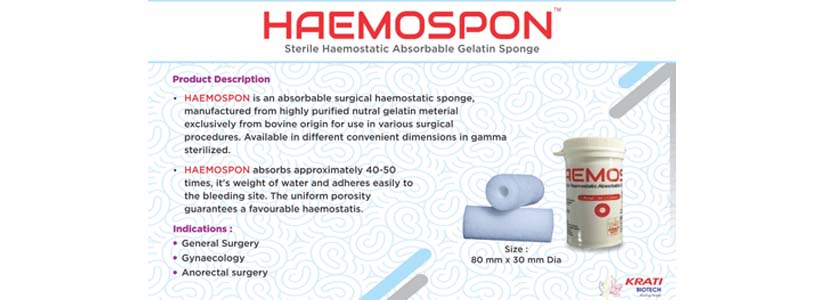
Sterile Haemostatic Absorbable Gelatin Sponge


INTRODUCTION

Gelatin is a substantially pure protein, obtained by thermal denaturation of collagen, which are the structural main stay and most common protein in the animal kingdom.

Gelatin sponges have been used in clinical practice as haemostats for more than 50 years and have been proven to be effective and safe as other types of haemostats.

PRODUCT DESCRIPTION

    HAEMOSPON is an absorbable surgical haemostatic sponge, manufactured from highly purified neutral gelatin material exclusively from bovine origin for use in various surgical procedures, where traditional haemostasis is difficult or impractical and use of other non-absorbable materials is undesirable. Available in different convenient dimensions in gamma sterilized form with suitable double sterile blister packaging or pouches for special sizes.

    HAEMOSPON absorbs approximately 40–50 times its weight of water and adheres easily to the bleeding site. The uniform porosity guarantees a favourable haemostasis. When implanted in vivo, it is completely absorbed within 3–4 weeks.

INDICATIONS

  • General Surgery
  • Gynaecology
  • Anorectal Surgery

Application Methodology

    HAEMOSPON is white, pliable, light and insoluble in water. It is removed from the package under strict aseptic conditions and can be cut to the required size, applied dry or saturated with physiological salt solution or thrombin or an antibiotic solution of the desired concentration.

    Squeeze the material between two fingers to remove the air bubbles so that the sponge, while immersed in the solution, will regain its original size and shape almost immediately. At the time of use, the superfluous solution may be allowed to drip upon a gauze compress.

    The saturated sponge is then applied to the hemorrhage area and is then held in place with moderate pressure for 10–15 seconds.

    Usually the first application of HAEMOSPON will control bleeding, but if not, additional applications should be made using fresh pieces of sponge. When bleeding is controlled, the pieces should be left in place; otherwise bleeding may start again. Since it causes little more cellular infiltration than the blood clot, the wound may be closed over it.